March 2025 · Student project
Orbit Jumper
Launch a character from a catapult into a field of planets and try to travel as far as possible. Gravity does its best to complicate the trip.
- My role
- C++ development · Physics
- Format
- 3D game · Physics
- Project status
- Prototype
- Technologies
01The project
Taking off is the easy part.
The idea is simple enough: a catapult, a ragdoll character and planets everywhere. You try to travel as far as possible using gravity, bounces and power-ups. As for landing, the character does what it can.
I worked on this prototype from 17 to 21 March 2025. Everything revolves around physics: planets pull the player in, surfaces affect bounces and collisions can completely change the trajectory.
How you play
- 01
Launch
Take off with a physics-based catapult.
- 02
Plan ahead
Read the planets and their forces.
- 03
Bounce
Work with the ragdoll and the surfaces.
- 04
Go further
Use power-ups to keep the journey going.
02My work
From the ragdoll to the online leaderboard.
I built the physics-based character and procedural planets, as well as the power-ups, shop and leaderboard. The work covered both gameplay and data saved online.
Character and physics simulation
I developed the ragdoll and its physics. The body reacts to forces and impacts, making movement unpredictable as soon as the player touches a planet.
Procedural planets
I built procedural generation for planets and their properties. Gravity, extra forces, hardness, friction and bounce can all vary. Two surfaces do not necessarily affect the player in the same way.
Power-ups and the systems around each run
I also developed power-ups, rewards, the shop and a leaderboard connected to a database. This part of the project links gameplay, the interface and online data.
03Under the hood
What shapes the trajectory.
The project is built in C++. Once launched, the character’s journey depends on the forces acting on it and whatever it hits. These are the main things involved.
What affects movement
Take a closer lookThe catapult gets things started.
The launch provides the initial impulse. The character then enters the planets’ gravity fields.
Planets pull the player in.
Their gravity fields and additional forces change the character’s course in real time.
An impact changes the rest of the trip.
A surface’s friction, hardness and bounce affect how the ragdoll reacts on impact.
Power-ups give you some control back.
You can change your trajectory with a boost, temporary anti-gravity, a mid-air relaunch or slow motion.
Each step explains one influence on movement.
Some development choices
Planets that play differently
If planets only looked different, every run would play the same way.
Their physical properties vary too. Getting close to a planet or touching it really changes how the attempt unfolds.
Keep choices available in flight
After launch, the player still needs chances to act.
Power-ups let you adjust movement. Between runs, rewards, the shop and the leaderboard give you reasons to try again.
04In pictures
The project on screen.
2 imagesClick to enlarge ↗
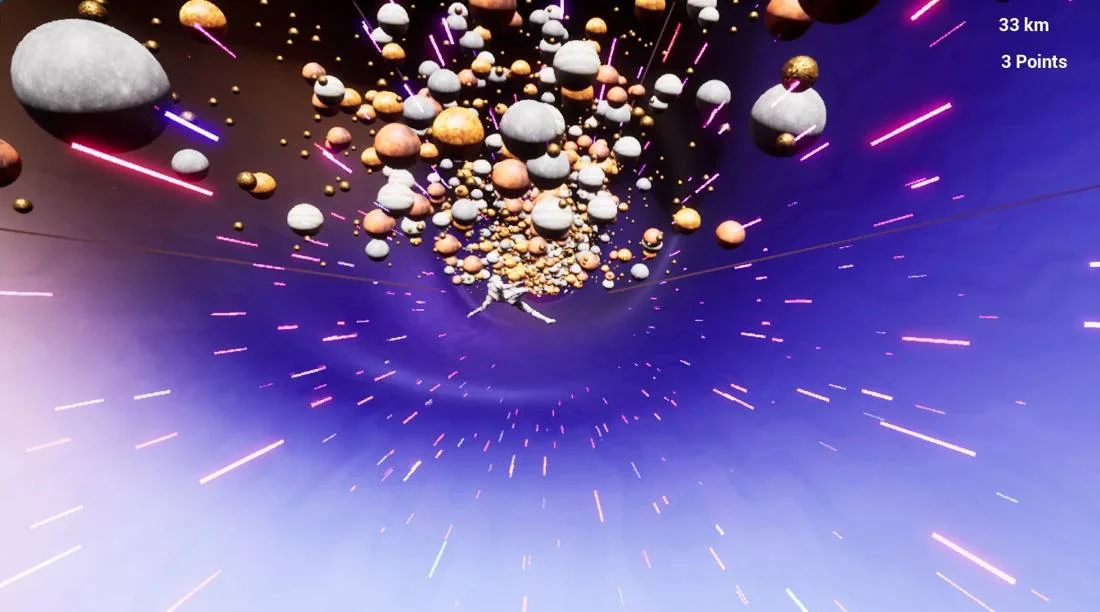
Two attempts in pictures, with distance and points in the top right.
In mid-flight
Lots of planets and a few chances to bounce.
Landing
The ragdoll meets a planet’s surface. Physics takes it from there.
05Outcome and team
A small physics playground.
This prototype had me working on character simulation, world generation and the systems surrounding each run.
What is in place
- Physics-based character and procedural planets.
- Power-ups, rewards and an in-game shop.
- A database-connected leaderboard.
Where the project stands
- The game remained a student prototype.
- The images show the version built during the project.
Here, changing a force or some friction is enough to change how you play. That is what makes working on physics interesting.
Want to talk about this project?
Let’s talkFrom one world to the next